|
Different uses for voting
need different types of voting. |

They can make a group more popular, yet stableand quick. 
|
 | Primer | See the merits of 4 great voting rules. |
| Games | See the simple steps in each type of tally. |
| The free eBook quickly covers both and a bit more. | ||
| El libro en español. O para America del Norte. 正确的 民主 Chinese. الكتاب الإلكتروني باللغة العربية Arabic. | ||
|
Democratic Solutions
This site shows ways to help democracy in any size, from a classroom to a country, and at all steps from choosing nominees to setting budgets. The tools and concepts build from one type of decision to the next: |
 | Single-Winner Election | Condorcet rules pick a widely-popular and central chairperson. |
 | Multi-Winner Election | Proportional Representation builds a diverse and balanced council. |
| Mixed-Member Council | The chair and reps make a centered and balanced council. New! |
| Policy Decision | Condorcet and rules of order lead to a central policy. New! |
| Project Selection | Fair Share Voting lets all big groups choose projects. New! |
| Budget Setting | Fair Share Voting responsibly adjusts all agency budgets. New! |

 The Northwestern U.S. was ripped apart for many years, as forestry policies were reversed again and again
What's Wrong? Our defective voting rules come from the failure to see there are different uses for voting, and these require different types of voting. “We try to carry over to more complicated situations a method which is only suitable in deciding the simplest sort of issue, that is, whether a question with only two possible answers shall be answered yes or no.” “For such an issue a simple majority election is, of course, sufficient.” But as soon as three candidates run for one office, the race becomes more complicated. Then a yes-no vote is no longer suitable. Sometimes what we want is not a solitary officer, but a council that represents all the voters. Then we do not need a system of dividing voters into winners and losers. Instead, we need a way of condensing them, in the right proportions, into their chosen leaders. |
|
DEMOCRACY EVOLVES |
|

Humor for politicians: Who wrote, “He is a barbarian and thinks the customs of his tribe... are the laws of nature.”
1) George Bernard Shaw, 2) Voltaire, 3) Pat Robertson, 4) Le Pen ?
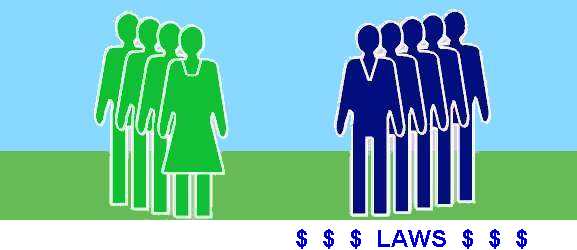 Typical Council Elected by a Plurality Rule The 1800s: Winner-Take-All Districts lead to Off-Center Councils.
Some English-speaking nations still use England's old plurality rule. It elects only one representative from a district, and winning it does not require a majority. It merely elects the one who gets the most 'yes' votes. In a district where only the biggest party wins a rep, only two big parties thrive. So the voters get only two real candidates; that is a very limited choice. Each district's bias tends to make its only seat 'safe' for one party. So most voters get no real choice. A few of those who do get choices can make majorities swerve from side to side. The council majority sets all policies (dark blue in picture) in another battle of winner take all. |
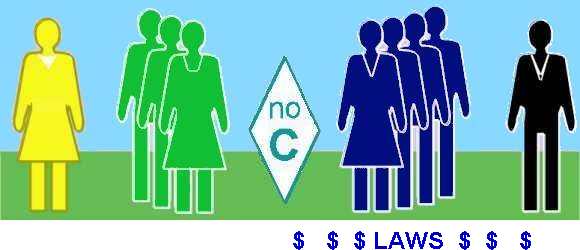 Typical Council Elected by a PR Rule 1900s: Fair-Share Representation leads to Off-Center Majorities. Proportional Representation (PR) was developed around 1900 to end some problems caused by plurality rule. Most democracies now use PR. It elects several people to represent each election district. PR can give a group that earns, say 20% of the votes, 20% of the council seats; thus PR always gives large groups their fair shares of seats. It leads to broad representation of issues and opinions. But usually there is no central party (C in picture); and the two biggest parties rarely work together. So the side with the most seats (blue and black) forms the ruling majority — and then enacts policies skewed to one side. |
|
2000s: Ensemble Councils lead to Broad, Centered Majorities.
New ensemble councils will elect most reps by PR, plus a few by a central voting rule (C in picture). The next page shows how a central rule picks winners with wide appeal and views near the middle of the voters. Its winners are thus near the middle of a PR council. So they are the council's powerful swing votes. Most voters in the winners' wide base of support don't want averaged or centrist policies. They want policies to unite the best ideas from all groups. |  |

|
A “centrist policy” enacts a narrow point of view; it excludes other opinions and needs. A “one-sided policy” also ignores rival ideas. A “compromise policy” tries to negotiate rival plans, but opposing plans forced together often work poorly.
In contrast, a “balanced policy” unites compatible ideas from all sides. This process needs advocates for diverse proposals. And more than that, it needs powerful moderators. | |
| A broad balanced majority works to enact broad balanced policies — which give the greatest chance for happiness to the greatest number of people. Excellent policies are a goal of accurate democracy. Their success is measured in a typical voter's education and income, safety and freedom, leisure and health.
Old tally rules often cause one-sided results and tragedies. An ensemble is inclusive; yet it is strongly centered and decisive. So it can make the organization popular, yet stable and quick. The best rules for spending and policies follow this pattern... ...as you can see on the quick graphic tour of the best voting rules. | |
|
The primer and games show why and how:
Different uses for voting need different types of voting. The best voting rules strengthen the ballots for voters. So they strengthen the mandates for winners. That means they lift the proven support for:
Power is more principled when we tally |
 a
a  a
a  a
a
| Next: the voting-rule primer |  |
|
A Map to Accurate Democracy
Six practical uses for voting shape this ebook.
| |||||
| Elections | Legislation | ||||
| Choice ballots
Tally pictures Tally table Instant Runoff Other rules Voting tactics Voting districts | Merits of PR
Women in PR STV for PR Visual STV Graphics 2 2D charts PR ballots | Merits
Merits 2 CW+STV Other rules Notes Seats Shares | Motions
Ballots Trades Tactics Cycles Other rules Amend | Uses
Needs Notes Sim Ballots Tallies LAR | $ Follies
Ballots Other rules Notes Medians HZ Points Coalitions |
| Condorcet's rule fills chapter 1 on electing a chairperson. Chapter 4 on setting a policy looks at it more deeply. Chapters 3 and 5 also use it.
Transferable votes are introduced by IRV and STV in chapters 1 and 2. Chapters 5 and 6 show how they can fund projects and departments. | |||||






| The key terms of this ebook (fair shares, mandates, transferable votes and Condorcet tallies) occur in almost every chapter. So the Table of Contents may help more than a search. | Printouts. | |
|
|
 español.
|
The voting simulation shows the character of each rule.
But it requires a basic knowledge of voting rules. The free software for voting does too. | 
|
NEW! The presentation about Fair Share Voting
from the 2012 Participatory Budgeting Conference!
English: Open Office slide show,
Printout (PDF).
Español: Open Office diapositivas,
impresora.
中国版 Chinese: Open Office 幻灯片,
打印 (PDF).
 We welcome questions, comments and corrections: We welcome questions, comments and corrections:
 Next: the voting-rule primer
|
|
Yes
 Yes
Yes Yes
Yes
Irish playwright G. B. Shaw satirized chauvinist pride
and ignorance in some leaders of the British Empire.
|
Searching for more? This discipline is fractured by many synonyms. Even its title varies: some call it public choice; others prefer social choice. College courses that look at voting theory include economics and comparative politics or comparative government. The table below has many terms that can help you find similar web sites. You will find most of these terms include topics other than methods for calculating winners from ballots. Searching for "voting systems" will bring you most often to sites that sell voting equipment. So will "election systems" and "ballot systems". "Election rules" bring up ballot access, campaign funding, media regulation and other laws while missing legislative voting. "Voting procedures" or "methods" suggest instructions for casting ballots. "Tally rules" is good but may neglect ballots or mean tallies of things other than votes. "Voting rules" is a simple term for ways of casting and counting votes.
The election chapters' terms for electing, nominating or selecting a:
The legislation chapters' terms to enact, set, pass, fund or budget:
Please try PoliticalSim tm (political sim), a free open-source political simulation game for Windows, and SimElection tm, electoral simulation software for Macintosh, for interactive simulations of approval voting, Borda rule, Condorcet rules (Minimax or Copeland), instant runoff voting (IRV, alternative vote, Hare), majority rule, plurality rule (aka first past the post, FPTP), proportional representation (list PR, full representation, proportional voting), single transferable vote (STV, choice voting), cumulative vote, limited vote, bloc vote and other voting rules.
| ||||||||||||||||||||||||||||||

|