|
Different uses for voting
need different types of voting. |

 |
Loring Ensemble Rule |
|

|
Loring Ensemble Rules combine Condorcet's rule with STV.
If such rules are not used, an STV tally might eliminate the overall favorite, the one who would be the Condorcet winner. That happens when she is surrounded by centrists and gets few first-rank votes. STV then elects no central candidate, or merely a centrist with a narrow appeal. The STV winners then elect a chairperson, usually from the center of the majority party, who is off center from the council and the voters. Loring Ensemble Rule a (LERa) makes the Condorcet winner exempt from elimination during an STV tally. Some ballots will move to her as other candidates are eliminated. In the end she will win a seat surrounded by reps who received ballots from less-central voters. Those less-central voters have some influence over who wins the chair. So the central voters might feel under-represented, but their rep becomes the chairperson. Sometimes there is no Condorcet winner due to a “voting cycle”. (Marcus Schulze notes that, “you don't need a tie breaker... You can just say, that a candidate cannot be eliminated, if he is in the Smith set and all other candidates of the Smith set are already eliminated.” LERa can use any variation of STV rules for quotas and transfers. It only requires helping the Condorcet winner avoid elimination. LERb elects her before the STV tally. Thus LERb will often give the majority group one more than its share of seats — making a council weighted toward the center. Note: 1) Some jurisdictions let voters recall their rep. PR fails to allow this: After a PR election we cannot trace a voter to his rep. So we cannot know which voters might ethically vote to recall each rep. In LERa, a Condorcet winner holds the votes from just a fraction of the voters during the STV tally; so, like other PR reps, we cannot recall her. LERb elects her before the STV tally; so all voters are eligible to vote for her recall. Note 2): LERa may resolve the debate about which quota rule is best. It can use Droop's quota, Voters/(Seats+1) +1 Vote, for the chairperson and use the remaining voters and seats in Hare's quota, (Voters/Seats), for reps. Droop's quota ensures the majority group gets the majority of seats while Hare's makes every vote count. Thus LERa can get the best of both quota rules. Note 3): By electing the most popular candidate(s) first and at no cost to the weight of a supporter's ballot, both LERa and LERb reduce the incentive for a free riding strategy by voters.
Separate votes for the chair and reps also give the majority an extra seat. But there are advantages in holding 2 separate contests: All STV votes and candidates are treated equally. It is easier to explain a basic STV tally than STV with 1 candidate exempt or “guarded.” (LERb matches those 2 points.) The best reason is that separate contests let voters rank candidates for chair on their ability to moderate, and rank the STV candidates on their ability to advocate. |
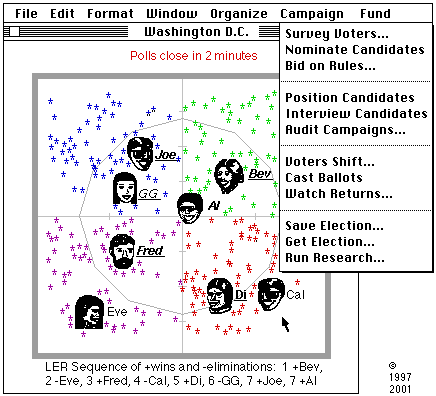
In this simulated election of a five-seat council, little stick figures  show the positions of voters. The huge heads are the candidates. show the positions of voters. The huge heads are the candidates.
Simulations show the LER voting rule is the best way to represent the center and all sides. Here it elects Al then Bev, Di, Fred, and Joe. (Labeled in bold) A Condorcet Series elects the 5 candidates nearest the central voter: Al, Bev, Fred, GG, and Joe. Nobody in the lower-right wins so the council cannot balance around the central voter. Bloc vote and Borda's rule elect the same off-center council. The STV winners? Bev, Di, Fred, GG, and Joe. No Al! Only LER has Condorcet centering with STV balancing! |
|
Software to tally Condorcet, STV and LER is free on the Tool page.
|




| |||||
|---|---|---|---|---|---|
| Electoral Systems | Legislative Systems | ||||
Chair
| Reps
|
Merits
More merits Condorcet + STV  Seats Shares | Policy
| Projects
| Budgets
|
 Accurate Democracy


|
|