|
Different uses for voting
need different types of voting. |

 |
Ensemble CouncilsCenter Majorities. |
|

Ensemble councils can form central majorities for balanced policies.
Humor 4 for politicians: Which Republican Party leader said “Our job is to
convince the voters that Democrats are the enemies of normal Americans.”
1) Lincoln 1860,
2) Eisenhower 1952,
3) Gingrich 1996,
4) Trump 2016
?
Democracy's Tragedies and FailuresThe most common problem in an election system is creating a council with an off-center majority and one-sided policies. Even with Proportional Representation, all government power goes to whichever side, left or right, has the most reps. Other reps and their voters are often powerless.This problem is pervasive. Examples of conflicts it inflames fill two pages linked below. They include loss of income and resources from reversals of timber policies. They include loss of unity and civility from decades of failing to resolve major political questions such as U.S. abortion laws, U.K. adoption of the Euro, or ways to simplify taxes, smooth financial speculation, and pay for pensions in many countries. 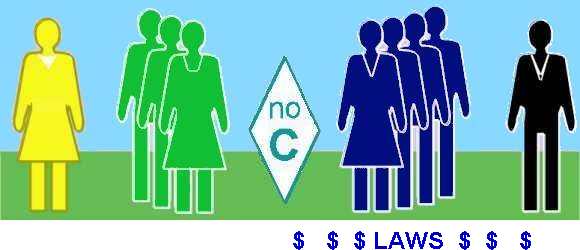
$ $ $ LAWS $ $ $  Typical Council Elected by a PR Rule
|
A Democratic SolutionTo avoid off-center majorities, a council's decisive votes should not belong to the left or the right. The powerful swing vote should belong to a central chairperson: the Condorcet winner.To give her the swing vote, the election must distribute the other reps fairly and evenly around the center. Proportional Representation, |

|
All ensemble rules tend to elect well-balanced councils like the one shown here, and the bold names on the PoliticalSim chart. An ensemble rule may help find a middle ground even if the voters are split unevenly. The council's swing vote will belong to a chair from the majority. But if the majority has no clear favorite in that election, the minority may cast the deciding votes. If so, the chair knows she owes part of her victory, and her care, to the minority voters. Footnote: A minority with 35% of the votes can win two of the five PR seats on a seven seat council. The two can build a majority with proposals that please the two central winners, the chair and vice-chair. Dynamics of Ensemble MajoritiesThis council’s reps know they must understand and propose policies that please the chair — and by extension, please moderates of the other side. In this it is a bit like consensus. But it does not push empathy as far as consensus and it is more decisive.Electing a central chairperson does not let a narrow, centrist minority of voters and their reps dictate the laws. The Condorcet rule lets all voters influence which central candidate wins, and it will elect only about 1 out of 5 council members; so the PR reps may try to form a ring majority with no centrists. As reps discuss an issue, the chair offers her views. If her policy is narrowly centrist, some reps may negotiate a broader policy, balanced with acceptable ideas from their rivals and key ideas of their own. Ensembles do not give a chairperson the power and celebrity of European prime ministers or American presidents and mayors. A PM often dominates a ruling party or coalition. A mayor commands the executive branch. But an ensemble’s chair often is not the center of a ruling party; she cannot command; she moderates a dynamic council. A Condorcet chairperson interested in re-election must try to balance each policy. A narrow or off-center policy exposes her to electoral defeat by a stronger moderator. All moderate reps have some power in majorities balanced around a chairperson who wants to stay popular on both sides of the center. An old one-sided majority included only half the moderates. Thus all moderates benefit from ensembles. The losers are people whose income or self-worth is measured by war-like politics. The chair's constituency is the whole populace, while the various reps advocate for narrower interest groups. This accurate democracy makes a council's views as similar to the electorate's as practical. Matching the median is priority 1 because policies often balance around the views of a council's swing voter. It is ironic that broad Proportional Representation helps a central Condorcet winner own a council's swing vote. It shows that political diversity can be a source of balance and moderation as well as perspective.
Story: In the Pacific Northwest, many jurisdictions are politically polarized, split almost 50:50, with no great concentration of voters in the center. The result has been intense hostility between poles, policy reversals and willfully irreversible policies. That pattern would be changed by ensemble rules. Neither pole could hope to capture a legislative majority. Reps would find that to win anything, they must work with the center and some moderates of the other pole. The new pattern may change our concepts of voting and government from tools for cultural war to tools for managing diversity. 1950. Germany's parliament has reps from one-winner districts and reps from party-list PR. It is a very successful election system. It is almost an ensemble but: The districts are not huge and heterogeneous; they use plurality rule so off-center candidates win most districts. These reps do not form a central balance point for majorities. Instead, the largest party usually forms a ruling majority with a minor party — excluding all reps of the second-largest party from decision making.
The next pages in this chapter explore the merits of ensemble rules and show a few tally methods. Before digging into the tally, it would be good to consider what kind of rule is best for policy making – the subject of the next chapter. |


 Previous use of voting |  Home voting overview |  Map & site search |  Tools to tally rules |  Explore this interest |  Next use of voting |


 |
|
Yes
 Yes
Yes Yes
Yes
Answer: Gingrich saw domestic policy differences as war.
|
Searching for more? Although ensemble rules are new, there are a handful of rules in use for combining PR with other voting rules. These combine national PR lists with local representation through plurality or runoff elections. Many quota systems were invented to favor either small parties or large parties. But those continued the war of left versus right. They did not lead to policies built around the political center. The voting glossary defines some of these.
| |||||||||||||||||||||||||||||||||